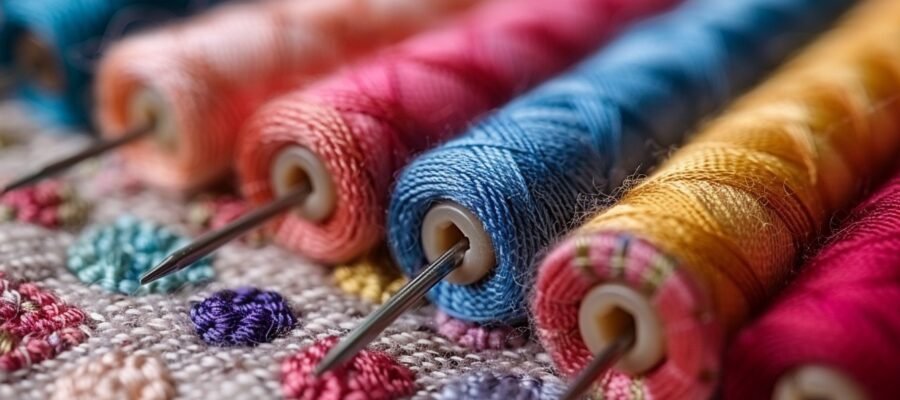
As a sewing enthusiast, I know how difficult it can sometimes be to choose the right needles for our projects. If you are a beginner or even an expert, the question often arises: «Which needle should I use for this specific fabric or technique?» » That’s why I’ll share with you my tips and tricks for choosing sewing needles.
Know the different types of sewing needles
First of all, it is essential to know the different types of needles available on the market.
- Universal needles: As the name suggests, they are designed for use on a wide variety of fabrics and techniques. They are therefore ideal for beginners.
- Ball needles: They are specially designed for elastic fabrics such as jersey and avoid piercing the fabric fibers.
- Very fine point needles: Perfect for fine, delicate fabrics such as silk, satin or lace.
- Leather needles: Ideal for sewing thick and resistant materials such as leather or imitation leather.
- Jeans needles: Designed for sewing thick, heavy fabrics such as denim.
- Quilting needles: Specially designed for quilting, they allow better penetration of the layers of fabric and wadding.
Remember to always check the compatibility of the needles with your sewing machine.
Choose the needle size based on the fabric
Once you have identified the type of needle you need, the next step is to choose the right size. Sewing needles are numbered according to their diameter, generally ranging from 60/8 (very fine) up to 120/19 (very thick). Here are some tips for selecting the appropriate size:
- Tissue fins: Choose a needle size between 60/8 and 70/10 to avoid leaving visible holes in the fabric.
- Medium fabrics: A needle size 80/12 will be perfect, for example, for medium cottons or jerseys.
- Thick fabrics: For half and other thick materials, choose a needle size 90/14 to 100/16.
- Very thick fabrics: If you are working on heavy leather or denim, you will need a needle size between 110/18 and 120/19.
But don’t worry, you don’t need to remember all these numbers! Most needle packages indicate the ideal type and size for each fabric. Don’t hesitate to carry out tests on scraps of fabric used before starting your project, to make any changes.
Match the needle to the thread you are using
The choice of needle is also linked to the thread you want to use. In fact, a thread that is too thick will not be able to pass through the eye of a small needle and, on the contrary, a thread that is too thin risks breaking with a large needle.
- For fine threads (cotton, polyester, silk), opt for a fine needle (60/8 to 70/10).
- The medium needle (80/12) is suitable for the most common cotton or polyester threads.
- For thicker threads (embroidery thread, quilting thread), choose a larger needle (90/14 to 100/16).
Keep needles well organized
It is important to take care of your needles and store them properly. I advise you to keep them in their original packaging or in a dedicated needle holder so as not to damage them and to always know which needle is suitable for which task. Also remember to change worn or damaged needles regularly to avoid sewing quality problems.
When should you change the needle?
Now that you know how to choose your needle, it’s crucial to know when to change it. Here are some signs that it’s time to replace the needle:
- Point jumps appear frequently.
- The thread regularly breaks while you sew.
- The needle makes a lot of noise when it enters the fabric.
- The stitching is uneven or the overall look of your work seems to be affected.
To ensure optimal sewing quality, do not hesitate to insert a new needle at the beginning of each new project or after approximately 8 cumulative hours of sewing.
About the author

Recent articles
To feel good about your clothes and have confidence in yourself, you need to have a well-stocked wardrobe. Dresses are essential elements of a woman’s wardrobe, but…
Sewing is a passion for many, but it can quickly become expensive. That’s why I offer you here a complete guide to finding free sewing patterns in…
Welcome to the exciting world of women’s coat designs! If you’re like me, admiring a beautiful coat always makes you want to start sewing…
Latest posts
How to wash, dry and care for bedding?
Curtains are an exclusive highlight of home interiors
Restless children’s sleep

Satin care: tips and guidelines
Why are satin bedding sets so popular?
Home textiles for sensitive skin
How to choose a dress model?
Baby blankets: why are they important and how to choose them?
Herbs: Natural Ways to Improve Sleep