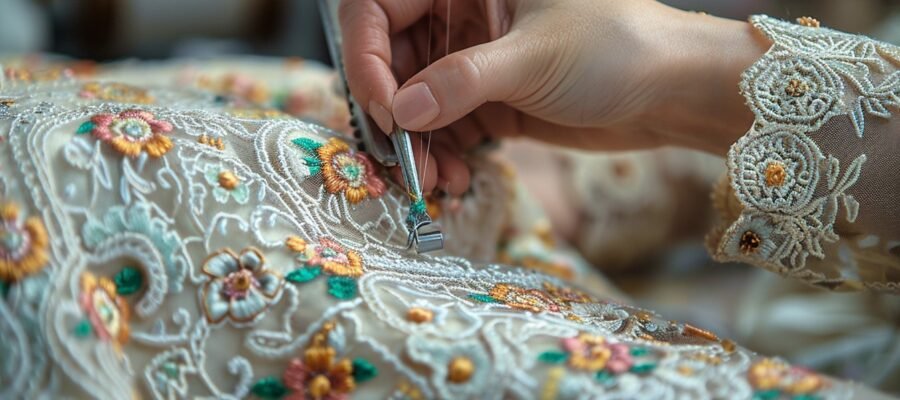
Everyone has faced this situation before: your favorite dress is too long or you need to re-hem after shortening the dress. The solution? Create a perfect hem yourself with some sewing tips. In this article I will share with you my seamstress tips and techniques for successfully hemming your dress.
Choose the right method depending on the material of the dress
Before starting, it is essential to choose the right hemming technique for the material of your dress. Here are some suggestions:
- Tissue fins: For dresses made of chiffon, silk or satin, prefer a hand- or machine-made rolled hem.
- Medium fabrics: I recommend a simple hem for fabrics like cotton, viscose or linen. Also consider invisible hand or machine stitching for a more discreet finish.
- Thick fabrics: Denim, velvet or wool suits often require a double hem, reinforced with topstitching or sergers.
Be careful not to use a technique that is too complex for your sewing level and don’t hesitate to ask those around you for help if necessary.
Take measurements and secure the hem
Once you have chosen the technique it is time to move on to the next step: taking measurements. Nothing is more frustrating than making a hem that’s too short or too long! Here are some steps to measure your dress correctly:
- Put on your dress and stand in front of a mirror.
- Use safety pins to mark the desired hem across the width of the dress.
- Carefully remove the dress, avoiding moving the pins.
- Using a tape measure, measure the distance from the bottom edge of the dress to the pin line. Write down this measurement as a reminder.
While pinning them, also make sure to respect the initial shape of the dress and its curves to avoid an unsightly result.
Cut and prepare the hem
Now that your dress is pinned securely, trim the excess fabric, taking care to leave enough allowance for the hem (usually between 1.5 and 3cm). Don’t hesitate to use fabric-specific scissors to avoid snags and protruding threads.
Iron and secure the hem before sewing
Once the cut has been made, make a first fold of the hem, marking the fold with an iron (be careful to choose the right temperature depending on the material). Then pin the hem at regular intervals to hold it in place while sewing.
Sewing the hem: the key points
We are there! Now let’s move on to sewing. Here are some tips for successfully hemming:
- Start with breakpoints: Before sewing, I recommend making a few small stitches at the front or back on the edge of the hem to prevent the thread from coming out during sewing.
- Choose the right thread: Use a thread that matches the color of your dress and is suitable for the material (cotton, synthetic, etc.).
- Maintain constant tension on the thread: Successful sewing also requires controlled thread tension throughout the entire job.
- Check alignment regularly: Don’t hesitate to stop the sewing machine and check that the hem is still aligned with the original edge of the dress.
Finally, don’t forget to remove the pins as you sew to avoid forgetting them and leaving them stuck in the hem.
Invisible sewing tips
If you want a discreet hem, opt for the blind stitch by hand or machine. This will hide the stitching on the right side of the dress by passing between the different folds of the hem.
Think about the final ironing
After making the hem, I advise you to give it a final press to secure it and eliminate any crease marks caused by the pins. This step is especially important for fine fabrics that tend to wrinkle quickly.
And here it is! You have successfully hemmed your dress with the advice of an expert seamstress. Now it’s your turn to practice regularly to master these techniques and achieve increasingly accurate results!
About the author

Recent articles
To feel good about your clothes and have confidence in yourself, you need to have a well-stocked wardrobe. Dresses are essential elements of a woman’s wardrobe, but…
Sewing is a passion for many, but it can quickly become expensive. That’s why I offer you here a complete guide to finding free sewing patterns in…
Welcome to the exciting world of women’s coat designs! If you’re like me, admiring a beautiful coat always makes you want to start sewing…
Latest posts

How to wash, dry and care for bedding?
Curtains are an exclusive highlight of home interiors

Restless children’s sleep

Satin care: tips and guidelines
Why are satin bedding sets so popular?

Home textiles for sensitive skin
How to choose a dress model?
Baby blankets: why are they important and how to choose them?

Herbs: Natural Ways to Improve Sleep